
You are using an out of date browser. It may not display this or other websites correctly.
You should upgrade or use an alternative browser.
You should upgrade or use an alternative browser.
Grand American Statistics and ATA Financials
- Thread starter Mike J
- Start date

Curious I guess ,
There is nothing on the State of Illinois web site saying there has been a balanced budget passed so again there has not been a budget in the State of Illinois for in excess of 12 years at least ... The States rating is at an all time low and going down based on financial obligations and their inability to pay ... The Lottery was ( is ) in trouble because they could not pay off winners so I will go and check that out on that site to see if anything has changed ... Madigan is a screaming mad man because with the tax increases and fuel tax increase they still cannot pay off any debt ...
Mike J. ,
If you know for a fact there has been a budget agreement please post a link so we can follow up on it and validate it ... I cannot find anything ... If any proposed budget was voted on and agreed to I doubt they would keep it a secret ...
Fact is the WSRC is dependent on the IDNR, who is dependent on the State of Illinois budget ... I will keep looking ... WPT ... (YAC) ...
Last edited:

Hey Garry my argument is with you. You made the statement. Now that you have been questioned....5 him haws later you blame it in the democrats and Dysinger. It’s your statement.
And trapshooting clubs are doing great in the Dysinger neck of the woods. ATA not so well.
Still waiting for the clubs that are hanging on.
And trapshooting clubs are doing great in the Dysinger neck of the woods. ATA not so well.
Still waiting for the clubs that are hanging on.
Gov. J.B. Pritzker inherited a $2.8 billion budget deficit the moment he stepped into office. Next year, that deficit is projected to be $3.4 billion1.
It’s the same story every budget season. But Illinois’ budget crises could be a thing of the past if the state would adopt pension reform, right-size its union contracts and focus education spending on classrooms instead of on administrative bloat.
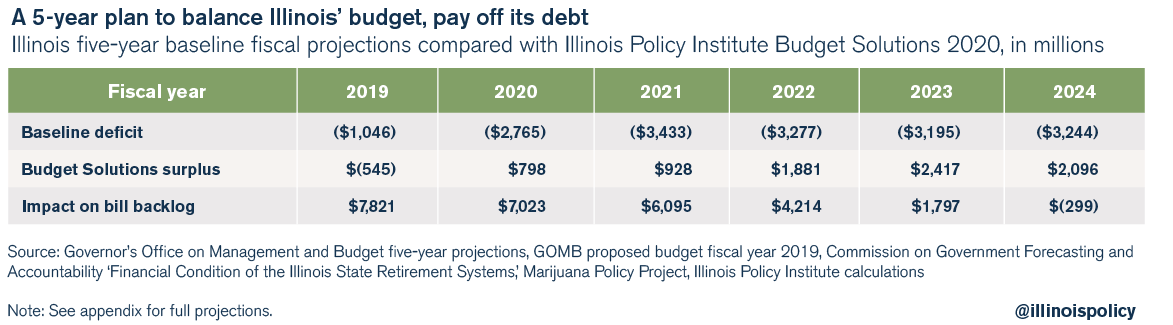
Addressing these main cost drivers now could turn the state’s perpetual deficits into surpluses in just five years, creating the opportunity to pay off debt, cut taxes and stimulate economic growth.
In fact, if this plan had been implemented four years ago, in fiscal year 2016, it might have protected taxpayers and services from the budget impasse. Over four years, these structural spending reforms would have saved a total of $12.6 billion. The bill backlog would be $4 billion lower than it is today, which would have made it possible to pay off Illinois’ bills entirely next year and cut the income tax the year after that without adding to the deficit.
In his first budget address, Pritzker has the chance to make structural spending reforms that will balance the state budget and put Illinois on a path toward completely eliminating its debt. With these structural spending changes, Illinois lawmakers could join the rescue and provide a deficit-neutral tax cut as early as fiscal year 2024, or use surpluses to shore up the state’s rainy day fund.
In other words, Illinois’ elected leaders can set themselves apart from decades of failed political leadership by stepping up to take heroic action. They can be the champions who save Illinois, and do it in five years.
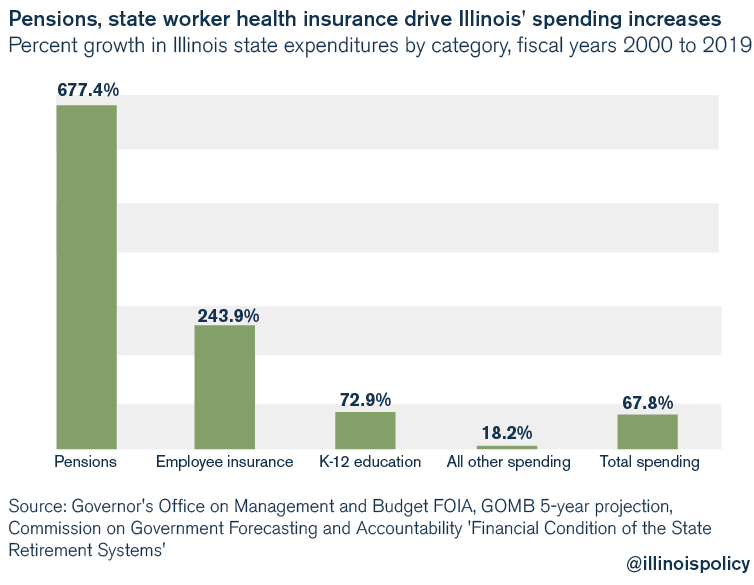
To effectively confront Illinois’ fiscal crisis, Pritzker must address the cost drivers of Illinois’ budget problems. A clear-eyed analysis of the math reveals which programs are driving overspending in Illinois. Since fiscal year 2000, state spending on pensions has grown more than 677 percent while total state spending has risen by 68 percent.
Pensions and government worker health insurance are growing faster than everything else, preventing the state from making investments in programs residents value, such as higher education, K-12 education, mental health services, the social safety net and more.
By embracing commonsense solutions, many of which have drawn bipartisan support in the past and could again, Pritzker and state leaders can accomplish what pessimistic Illinoisans might have thought impossible. The solutions are as follows:
1. Real, lasting pension reform: Savings of $12.2 billion over five years
a. Amend the state constitution so that it still protects earned benefits, but allows changes in future benefit accruals. Then, reintroduce reforms similar to those passed through the Democratic supermajority-controlled General Assembly and signed by a Democratic governor in 2013.
b. Align responsibility for setting benefits with accountability for paying benefits at schools and universities.
2. Invest in classrooms over bureaucracy: Savings of $2.9 billion over five years
a. Invest more money in classrooms, students and teachers by reducing administrative bloat through school district consolidation.
b. Increase education funding to keep pace with inflation rather than the $350 million annual increases envisioned in the state’s new “evidence-based” education funding formula.
3. Ask government unions to play fair at the bargaining table: Savings of $4.2 billion over five years
a. Limit automatic pay raises for some of the nation’s highest-paid state workers
b. Right-size group health insurance costs while maintaining quality care
WPT … (YAC) …
It’s the same story every budget season. But Illinois’ budget crises could be a thing of the past if the state would adopt pension reform, right-size its union contracts and focus education spending on classrooms instead of on administrative bloat.
Addressing these main cost drivers now could turn the state’s perpetual deficits into surpluses in just five years, creating the opportunity to pay off debt, cut taxes and stimulate economic growth.
In fact, if this plan had been implemented four years ago, in fiscal year 2016, it might have protected taxpayers and services from the budget impasse. Over four years, these structural spending reforms would have saved a total of $12.6 billion. The bill backlog would be $4 billion lower than it is today, which would have made it possible to pay off Illinois’ bills entirely next year and cut the income tax the year after that without adding to the deficit.
In his first budget address, Pritzker has the chance to make structural spending reforms that will balance the state budget and put Illinois on a path toward completely eliminating its debt. With these structural spending changes, Illinois lawmakers could join the rescue and provide a deficit-neutral tax cut as early as fiscal year 2024, or use surpluses to shore up the state’s rainy day fund.
In other words, Illinois’ elected leaders can set themselves apart from decades of failed political leadership by stepping up to take heroic action. They can be the champions who save Illinois, and do it in five years.
To effectively confront Illinois’ fiscal crisis, Pritzker must address the cost drivers of Illinois’ budget problems. A clear-eyed analysis of the math reveals which programs are driving overspending in Illinois. Since fiscal year 2000, state spending on pensions has grown more than 677 percent while total state spending has risen by 68 percent.
Pensions and government worker health insurance are growing faster than everything else, preventing the state from making investments in programs residents value, such as higher education, K-12 education, mental health services, the social safety net and more.
By embracing commonsense solutions, many of which have drawn bipartisan support in the past and could again, Pritzker and state leaders can accomplish what pessimistic Illinoisans might have thought impossible. The solutions are as follows:
1. Real, lasting pension reform: Savings of $12.2 billion over five years
a. Amend the state constitution so that it still protects earned benefits, but allows changes in future benefit accruals. Then, reintroduce reforms similar to those passed through the Democratic supermajority-controlled General Assembly and signed by a Democratic governor in 2013.
b. Align responsibility for setting benefits with accountability for paying benefits at schools and universities.
2. Invest in classrooms over bureaucracy: Savings of $2.9 billion over five years
a. Invest more money in classrooms, students and teachers by reducing administrative bloat through school district consolidation.
b. Increase education funding to keep pace with inflation rather than the $350 million annual increases envisioned in the state’s new “evidence-based” education funding formula.
3. Ask government unions to play fair at the bargaining table: Savings of $4.2 billion over five years
a. Limit automatic pay raises for some of the nation’s highest-paid state workers
b. Right-size group health insurance costs while maintaining quality care
WPT … (YAC) …
How much in debt is Illinois?
Local: $50.8 billion
This is the first report to give a complete picture ofIllinois' total retirementdebt. All told, state and local governments in Illinois owe more than $203 billion for pensions and retiree health insurance. This is more than $41,000 in retirement debt for every Illinois household.
WPT … (YAC) …



Garry
Mega Poster
Hey Family Guy, get off your high horse. There is no need for you to be arguing with me. Dysinger said in 1998 that clubs all over the United States have been closing. Brad was right and that's a fact. If you want the names of the clubs that have closed, look them up yourself ! I am tired of playing your game !

BRAD DYSINGER
The Philosophist
Member Trapshooting Hall of Fame
Founding Member
Member State Hall of Fame
wpt I like your facts on Illinois finances, I doubt that Mike J can construct a Winstonest chart in rebuttal of your post so I'm going to throw some other facts at him in an other direction.
Going by Mike J's own chart every state but one had fewer shooters at this years grand than they did at the very first Sparta grand, so it looks like the boycott is well spread out across the country. A fantastic direction comes to my mind.
The one state with more shooters is Iowa 149 in '06 and 168 in'19. Every other state is down some at 50% levels and more. Just how do these numbers prove that the grand is a success. I don't know about the states left out of Mike J's list one way or the other. If you really want to see some eye popping numbers check out the 2004 Vandalia grand numbers for these same states.
On another note Mike J I said that between the OSTA and the Foundation the OSTA has about 3/4 million bucks, so a smart person would see it is in the foundations coffers. And if the EC takes Jack's offer (I hope they don't, and I said so to the powers that be) Ohio will be getting 1.6 cents per bird from that shoot.
A couple of the trap clubs that have closed around Ohio were Jaqua's and Great Eastern both private owned registered type clubs. Both owners sold the ground as it was worth a boatload in each case. The trap clubs out west like in Nevada, that I used to shoot at closed for lack of shooters mostly, and high real estate prices. Around me here in Ohio our small 2,3,4 trap game clubs are doing alright but they don't shoot any ATA events. Williams,County is about the only club that shoots registered targets in NW Ohio that is doing well and they have large non registered shoots too. Registered shooting in Ohio is way way off. Not counting the CC of course.
No one can argue with you? Anyone that does is on a high horse? Could be forums aren’t for you.Hey Family Guy, get off your high horse. There is no need for you to be arguing with me.
I remember you wanted a thread closed that you recently started. Didn’t want anymore comments.
You may want to get off your high horse and prepare to be challenged. It’s what we do here.
Mike J.
I do not want to load this site with the garbage about the State of Illinois so if you don't mind I will pick some of the points of interest out of some of the links and or articles for you to ponder ... The Budget that was agreed upon was 10.2 Billion short of what was needed to make it to the break even point for the year ... The State of Illinois is at present 50.8 Billion (with a "B") in debt so a proposed budget of 40.6 Billion leaves them up side down 10.2 Billion ... I am researching the line items to try and find the funding you were told about, as of yet I cannot find it ... There has been a lot of things said over the years and seldom were they backed up, yet were taken as fact because of who said what to who ... That don't work anymore ... WPT ... (YAC) ...
I do not want to load this site with the garbage about the State of Illinois so if you don't mind I will pick some of the points of interest out of some of the links and or articles for you to ponder ... The Budget that was agreed upon was 10.2 Billion short of what was needed to make it to the break even point for the year ... The State of Illinois is at present 50.8 Billion (with a "B") in debt so a proposed budget of 40.6 Billion leaves them up side down 10.2 Billion ... I am researching the line items to try and find the funding you were told about, as of yet I cannot find it ... There has been a lot of things said over the years and seldom were they backed up, yet were taken as fact because of who said what to who ... That don't work anymore ... WPT ... (YAC) ...
Thanks WPT, nice charts. I'll bet even an engineer could understand them. If you would have told me that all it took to shut him up was a pie chart I would have done that after his first baiting post. LMAO
Number of Trap shooters in the US
Number of "registered target" Trap shooters in the US
Number of "registered target Trap shooters" that shot EVENT 24 in 2019
Number of NY registered target Trap shooters that actually shot Event 24 in 2019
(What's with all the boycotters from NY?)
Number of engineers from NY that shot Event 24 in 2019
Of course if you are an N1H1(Swine Flu) true believer, and official Kool-Aid tester, you believe only the "registered" people shoot REAL Trap. That is just as funny and idiotic now as the day he posted it.
Dysinger was right and so is HB
Brad, like I said many times the Grand is not hurting the rich is having fun being able to shoot 2,600 targets in 10 days with the highest competition factor. The poor now shoot locally many in leagues. Trap is alive and kicking where I live.
But Brad, OSTA really only have about $43k in it's name? I thought you said they had 3/4 million.
First, it's THE RICH ARE not THE RICH IS. Skipped that writing class did you?
Like I said before, this guy is not only a troll but an arrogant troll at that LOL
I know one of those POOR local shooters, He shows up every Thursday night in his Hummer and pulls the Seitz out of the back to shoot Annies for $2.00 a piece. Past AA27A registered shooter(10K combined a year) that quit the ata because it wasn't worth it. They get 30 guys on the line and more than half of them could buy and sell you mikej.
In all my years of shooting pigeons I was fortunate enough to meet more than a few VERY RICH men. NOT ONE of them EVER tried to impress anyone with how much they spent on their choice of shotgun disciplines or how much they spent at a shoot. Their back up gun was worth more than your yearly "shooting" budget.
$4,000 in how many days did I see you shot? 10? Chicken feed as they say in Guyana. Do a little homework and ask some of your pals how much Flyers costs before you say something that will make you look foolish. AGAIN
It was always the no talent loud mouth with a few dollars in his pocket that went around trying to impress us with how much he spent or where he shot. Funny really. We understood that it made him feel important but in reality most of us just felt sorry for the poor guy. Kinda the way I feel about you. I just shake my head and smile.
You do realize that there are a LOT of people on here that have a LOT more money than you right? Your 15K a year you claimed you spent "shooting"? Chump change to them.
At least lie if you are going to try and impress us. You never know, I might not be able to find out if you are telling the truth. Then again, now a days with the internet someone can find out almost anything about anybody.
BRAD DYSINGER
The Philosophist
Member Trapshooting Hall of Fame
Founding Member
Member State Hall of Fame
Flyer your last post is spot on. I miss Holford's Club, I bet Mike J don't know what state that was even in.
Flyer your last post is spot on. I miss Holford's Club, I bet Mike J don't know what state that was even in.
I doubt if he knows what country. I do know if I mention the word bet to mikej it scares him off but if I bet you and lose can I use the neil winston payment plan?
HB,
Some time ago I believe it was you who had the number of ATA Registered clubs from year to year.
I believe it was just a few short years ago there were over 1,000 clubs throwing Registered, this year I believe the list had dwindled below 900.
If you were the one, and still have that list, could you please post it.
My personal opinion is they (Like my old home club in NY) have mostly gone the way of Sporting Clays.
Thanks
Gov. J.B. Pritzker inherited a $2.8 billion budget deficit the moment he stepped into office. Next year, that deficit is projected to be $3.4 billion.
It’s the same story every budget season. But Illinois’ budget crises could be a thing of the past if the state would adopt pension reform, right-size its union contracts and focus education spending on classrooms instead of on administrative bloat.
Addressing these main cost drivers now could turn the state’s perpetual deficits into surpluses in just five years, creating the opportunity to pay off debt, cut taxes and stimulate economic growth.
Governor Pritzker noted that if the Unions played fair and went along with the Pension reform there is a possibility of a balanced budget in 5 years that as of now the pension debt is 209 Billion and mounting ... I have searched the line items on the budget that was voted and agreed to and there is no specific allowances for recreation, IDNR, repairs of State Parks, but there are increases in class room and educational funding (Pooled together ) ... The State increased the confusion in breaking down the budget by pooling departments so it looks like there is more funding when in reality there is less if they were individual ... Politics as usual in the State Of Confusion and Corruption (Illinois) ... I will continue the search ... WPT ... (YAC) ...
These are the current closures in Southern Illinois.
Region 5 - Southern Illinois
Region 5 - Southern Illinois
Last updated: 8/2/2019
- Beall Woods - Tuliptree and White Oak are open. Schneck, Sweet Gum and Ridgeway trails are closed.
- Cave In Rock - Due to an ongoing construction project near the Cave please be aware there may be some footing hazards. Access to the Cave may be blocked at times due to this project.
- Dixon Springs State Park - The pool has closed for the season. It will reopen in 2019. Cabins and Barracks are closed until the end of March.
- Embarras River Bottoms State Habitat Area - is closed due to flooding.
- Fort Massac – The boat ramp is closed due to flood waters. The 1912 restrooms and Rock Toilet restrooms are closed for repairs due to flood damage. The inside of the 1802 American Fort will be closed to the public until further notice for public safety.
- Giant City State Park - The horse trail is open but riders should follow detour signs where posted.
- Golconda Marina – Rauchfuss Hill is currently closed.
- Horseshoe Lake - Alexander County - Most of the site is not accessible at this time due to flood waters. The East Side Campground and the Ferry Landing are closed due to storm damage. The lake is open to fish as well as the Public Hunting Area for snow goose hunting by boat only. The bike and hiking trails are currently closed.
- Kinkaid Lake - Kinkaid Lake spillway is closed due to flooding.
- Mermet Lake - Mermet Lake will be closed in its entirety for the first four (4) days of squirrel hunting season - August 1 - 4, 2019 due to the National Archery Tournament.
- Newton Lake – Section 6 Pond (Hamm James) is currently closed. The mountain bike trail is closed indefinitely due to washed out areas.
- Pyramid State Park - A portion of road going to the Boulder Lake boat ramp and campground will be closed due to water over the road.
- Rauchfuss Hill - Closed until further notice.
- Red Hills State Park - The Trace Inn is currently closed.
- Rend Lake - The hunter access road has been closed due to the rising water levels of Rend Lake. Power has also been turned off at Hickmans Point Campground due to the flooding.
- Sahara Woods - The OHV construction area at Sahara Woods will be closed to all activities until further notice due to ongoing construction. This includes roughly 1400 acres of the northwest part of the park.
- Stephen A Forbes State Park - Lakeside Restaurant is currently closed. Lakeside Marina is open, please contact the Park office for Information.
- Trail of Tears State Forest - North and South Forest Roads will be closed December 24 through the end of Spring Turkey Season.
- Wayne Fitzgerrell State Park - Shelters are closed for the winter. Class "A" camping area, bike trail and shelter areas are closed for a disabled shotgun deer hunt November 2nd, 3rd and 4th and will reopen Monday, November 5th. Shady Rest camping loop will reopen by 9 am Monday morning and will stay open the remainder of the winter.
A look around the state suggests that the Park system in very unhealthy.
BRAD DYSINGER
The Philosophist
Member Trapshooting Hall of Fame
Founding Member
Member State Hall of Fame
wpt and The Phatom facts, are that all you got just facts. No future for you in the news media or the ATA I say.
BRAD DYSINGER
The Philosophist
Member Trapshooting Hall of Fame
Founding Member
Member State Hall of Fame
Oh I forgot NO KOOL AID for you guys today.
You guys really like that $hit, eh?? Even laced with cyanide?? Come on what's wrong with you people LOL.Oh I forgot NO KOOL AID for you guys today.
Anyway, see you next year for the 15 Annual celebration of the death of the ATA and Grand.
The time I spent here in couple weeks I could have made much more consulting than Flia won the entire year at the casino. It might be less than his losses, however. See yah.
I was wrong about one thing. I thought this guy would have had the balls to stay.
Now he mentions my name.
All the posts asking him about why the NY shooters boycott that shoot?
All the requests to back up any of his idiotic posts?
ANY legit questions that he ducked?
And then he tries to take a swipe at me about the money. Jealous?
Here's the deal. This guy is from NY. Shot for a little while. Broke LOUSY scores then quit. He proves he is a quitter again by running away from us here. Started back and is still shooting LOUSY scores but feels that he has to defend the ata.
From his earliest posts on this thread he wanted everyone to know how much money he had. Not really that much but to him a fortune.
Correct me if I'm wrong about where you went to school AKA mikej
Upon a request from people with more patience when it comes to dealing with aholes I have edited my post
Anyone that wants to "sue me" can.
IF YOU HAVE THE BALLS
I know I'm safe because AKA mikej doesn't
Anyone want to make a bet he lied when he said he was out of here?

You know the guy? You better call him right now. It should be easy, just dial your own number
Going to sue me? Now you have me scared.LOL
I thought you were leaving
BTW, it's anybody's name NOT anybody name
Skipped another writing class didn't you?
Going to sue me? Now you have me scared.LOL
I thought you were leaving
BTW, it's anybody's name NOT anybody name
Skipped another writing class didn't you?
HB,
Some time ago I believe it was you who had the number of ATA Registered clubs from year to year.
I believe it was just a few short years ago there were over 1,000 clubs throwing Registered, this year I believe the list had dwindled below 900.
If you were the one, and still have that list, could you please post it.
My personal opinion is they (Like my old home club in NY) have mostly gone the way of Sporting Clays.
Thanks
I found an old post on the subject, but don't at the moment have current club information.
I did see a trend though.
In 2004, the ATA notes in the Average Book the following figures:
1. 34,920 ATA members
2. 6,613 registered tournaments
3. 84,806,630 total targets thrown
4. 1,096 registered ATA gun clubs
The 2014 Average Book has the following numbers :
1. 28,212 ATA members
2. 6,252 registered tournaments
3. 56,552,155 total targets thrown
4. 850 registered ATA gun clubs
Copied from History Buffs posting and reprinted , does any one see a problem ..?
The ATA claims to promote trapshooting which does not seem to be the case according to the figures and the gradual decline in 10 short years ... What ever they are doing, they should try just the opposite, this is not working ... WPT ... (YAC) ...
wpt, Feb 20, 2016
As I said I know the guy personally and it was agreed that I can post about his cart and he will answer any calls as if I am him and also let others who want to know who I am think it's him. He has no interest here.
So, you lied when you said it was YOUR cart.
Why doesn't that surprise me?
Two masters? Wow, hope you told the truth to get them.
Don't try to BS me. I outed you and since you know the "sue me" threat is also BS you want to weisel your way off the site.
Well at least the administrator did the right thing and removed the guy's name. We will see how this goes.
Here, let me fix your post for you
I'm not an administrator
I removed YOUR name because I figured YOU are just petty enough to try and discredit this site with some BS. I know who you are, I just wanted you to know that. Almost crapped your pants huh?
You said it was YOUR cart
That was a LIE
Before my Father passed away from Parkinson's he always said the only thing worse than a thief was a liar
At least you know what a thief is doing
You want to make another crack about spoon feeding someone with Parkinsons?
You arrogant foreigner
HB was right
"The time I spent here in couple weeks I could have made much more consulting than Flia won the entire year at the casino. It might be less than his losses, however. See yah."
Anyone need more proof about what this guy is?
SEE YA, usually means goodbye. As in, I'm leaving
adios
adieu
addio
adeus
aloha
arrivederci
ciao
auf Wiedersehen
au revoir
bon voyage
sayonara
Like the Zen Master said
We'll see LOL
And if you're not lying this time, fat chance, and really are leaving let me be the first to tell you MY goodbye
********************************************AMF*************************************
Last edited:
Thank You WPT for all the work
Jack shooter
New Member
This post from the guy that did not know you don’t have to have a photo I.D. to get classified. LOL
Great idea having the shoot in the gun hate state. They only CLASSIFIED a little more than 700 from Illinois.
That is false. I didn't show ANY ID to classify other than my ATA card.
Quick hits: Illinois news in brief for Friday, Aug. 30
Overdue, outdated financial report shows Illinois' deficit grew by $6 billion
Illinois overspent by around $6 billion in the fiscal year that ended nearly 430 days ago.
That’s according to the latest Comprehensive Annual Financial Report for fiscal year 2018.
Truth In Accounting Research Director Bill Bergman said the report for the first time recognized $55 billion in other post-employment benefits for retired government workers.That’s up for what Bergman estimated for the year before.
Unfunded liabilities for state government employee retirement benefits plus state pensions now total more than $188 billion.
Gov. J.B. Pritzker signs 591 bills, vetoes 8
For the first time in months, Illinois' governor has a clean desk as the 599 bills state lawmakers sent have nearly all been signed into law.
Gov. J.B. Pritzker vetoed or partially vetoed eight bills. \
Lawmakers come back in October and November for six days to consider whether to override his vetoes. They can also pass new legislation.
New law to help craft distilleries in Illinois
A new state law is expected to help craft distilleries in Illinois get their products to consumers.
The Illinois Craft Distiller’s Association said House Bill 2675 offers parity for craft distillers by allowing smaller distilleries to distribute their spirits to restaurants, bars and stores.
That’s something distillers hadn't been allowed to do. Distilleries will also be able to open “distil pubs,” like brewpubs.
WPT … (YAC) …
- The Center Square
- Aug 30, 2019
Overdue, outdated financial report shows Illinois' deficit grew by $6 billion
Illinois overspent by around $6 billion in the fiscal year that ended nearly 430 days ago.
That’s according to the latest Comprehensive Annual Financial Report for fiscal year 2018.
Truth In Accounting Research Director Bill Bergman said the report for the first time recognized $55 billion in other post-employment benefits for retired government workers.That’s up for what Bergman estimated for the year before.
Unfunded liabilities for state government employee retirement benefits plus state pensions now total more than $188 billion.
Gov. J.B. Pritzker signs 591 bills, vetoes 8
For the first time in months, Illinois' governor has a clean desk as the 599 bills state lawmakers sent have nearly all been signed into law.
Gov. J.B. Pritzker vetoed or partially vetoed eight bills. \
Lawmakers come back in October and November for six days to consider whether to override his vetoes. They can also pass new legislation.
New law to help craft distilleries in Illinois
A new state law is expected to help craft distilleries in Illinois get their products to consumers.
The Illinois Craft Distiller’s Association said House Bill 2675 offers parity for craft distillers by allowing smaller distilleries to distribute their spirits to restaurants, bars and stores.
That’s something distillers hadn't been allowed to do. Distilleries will also be able to open “distil pubs,” like brewpubs.
WPT … (YAC) …
I think if they could get the WSRC to up the attendance considerably they could get caught up in no time ... There is no money in the fiscal budget for improvements on any of the States, State parks ... The Budget is posted on the State of Illinois site, will not up load for what ever reason ... Most of the recreational services have been cut, IDNR has taken a huge cut, and the list goes on and on ... Business as usual in Illinois folks, been that way for years ... Up the Taxes ... WPT ... (YAC) ...
If the state of Illinois bails out local pension funds, its total pension debt would grow to $200 billion, up from $137 billion today.
Chicago Mayor Lori Lightfoot has already floated the idea of a state bailout of Chicago pensions. But a bailout of local pension debt – Chicago included – would cause the state’s already massive annual budget deficits to explode, with pension contributions spiking by nearly 56%, or $5.67 billion, in fiscal year 2021. This would inevitably trigger tax hikes.
Gov. J.B. Pritzker declined Lightfoot’s pension bailout request back in July. It’s not hard to see why: Illinois’ pension debt-to-revenue ratio – one gauge of a state’s ability to repay debt – is over 600%, the worst in U.S. history.
Moreover, pension debt is the primary reason Illinois’ credit rating remains the worst in the nation. A bailout would almost certainly lead to a credit downgrade and further increase the cost of borrowing.
Some have suggested consolidation of pension funds and boards as a solution to the pension crisis. Consolidating pension funds can help make them more efficient, save some money on administrative fees to asset managers and potentially help the funds achieve higher asset returns. However, the prospect of consolidation also comes with risks. First, lawmakers could attempt to sell consolidation as a silver bullet solution when the reality is it would be only a small step in the right direction that does nothing to solve the underlying debt problem. Second, consolidation would likely be used as cover for a state bailout of local pension funds.
Soaring pension costs have impaired Illinois’ ability to invest in core services that residents value. Adding local pension costs to that burden is simply not feasible. Instead, Springfield must control those costs by leading the state toward constitutional pension reform that protects earned benefits while allowing reasonable adjustments to the growth of future, unearned benefits.
Where are they ever going to get the money to support the WSRC or any State Parks ..? WPT ... (YAC) ...
WPT,
Do you know when IDNR traditionally publishes their calendar of events for the upcoming year at WSRC?
Do you know when IDNR traditionally publishes their calendar of events for the upcoming year at WSRC?
They continually up date it as they go from what I can see or figure … I tried going to the IDNR web site to see if that information was available, didn't appear to be unless maybe I missed it … I know in 2017 they had a chit load of events posted that never happened for what ever reason ( they do not give reasons being as they are the State ) … The latest and newest thing is the State has rugs all over so they can sweep stuff under them and then no body brings them up so they do not have to be discussed … (so it seems, kind of the ATA, Gipson etc ) … WPT … (YAC) …
Rn3,
Thank you! Unfortunately, I was only able to find scheduling posted up to the end of 2019. I was hoping to find scheduling for the upcoming year, or 2020. How do I find that?
The P
Thank you! Unfortunately, I was only able to find scheduling posted up to the end of 2019. I was hoping to find scheduling for the upcoming year, or 2020. How do I find that?
The P
Doesn't look like they have released 2020 yetRn3,
Thank you! Unfortunately, I was only able to find scheduling posted up to the end of 2019. I was hoping to find scheduling for the upcoming year, or 2020. How do I find that?
The P
09-16-19
A new memo from the governors office warning Illinois state agencies of future budget cuts is the latest challenge underscoring the severity of the state’s pension crisis.
The memo instructs state agencies to include in their budget requests for the next fiscal year a scenario that anticipates a 6.5% across-the-board cut to their agency budgets. It also advised to explore ways to cut commissions and boards under each agency’s purview by 10% and requested “at least two significant efficiency and savings ideas” from each agency.
The memo comes three months after Pritzker praised state lawmakers’ passage of a “real balanced budget” that topped $40 billion. The Illinois Policy Institute’s analysis at the time found the budget for fiscal year 2020 to be as much as $1.3 billion out of balance.
Oh no say it isn't so … More budget cuts in the State of Illinois … WPT … (YAC) … "OH MOMMA" ...
Last edited:
News update ::: This just in ...
East St. Louis, Illinois, is home to the highest murder rate of any American city. Two-thirds of its children live in poverty.
In other words, $2.2 million for the city goes a long way.
But thanks to the reckless promises of Illinois politicians, $2.2 million in state funding for East St. Louis is set to be “intercepted” by Illinois Comptroller Susana Mendoza’s office, and dumped directly into the local firefighters pension fund, which has just 9 cents on hand for every dollar it needs to pay future benefits.
WPT … (YAC) …
Does any one know how much in fees the C.C. pays to the ATA every year? Please post if you have that info. Roger C.
using the attendance on Stuart's site. 22,788 entries for all shoots at Cardinal. @ $3/ea thats 68,364 in daily fees

You only pay the fee once per day, not every event.using the attendance on Stuart's site. 22,788 entries for all shoots at Cardinal. @ $3/ea thats 68,364 in daily fees
.
You need to know how many days they registered targets. Also how many shooters shot on each day. then you can figure the payment to the ATA. Roger C.