Let's move on to
" The Pattern good or bad will only give you the Static results at that particular spot not before or after (multidimensional) so its virtually meaningless in figuring out how to eliminate any holes in the pattern by adding or lessening choke constriction ... The odds of that hole being in another pattern in the same exact place is ZERO"
In which the writer managed to shoehorn four mistakes in only three lines.
Mistake #1,
"The Pattern good or bad will only give you the Static results at that particular spot not before or after (multidimensional) so its virtually meaningless..."
A pattern will be smaller when tested closer, larger when tested farther away, There's no reason to think that these patterns will change places, for example, in reasonable changes of range. Targets shot at 34 yards look like the earlier ones shot at 40 yards, they are just tighter.
Here are modified and extra-full choke tubes in a 391 Beretta with a 0.732" bore shot at 34 yards.
And are a Bowen (0/740" bore) and the bottom barrel of an old Perazzi O/U whose under-barrel had a constriction of 0.023", a bit tighter than modified, again shot at 34 yards.
These guns were tested seven years apart, shooting different (but good) shells, and differ completely in everything but choke-constriction. Look how similarly they shoot! If the writer has evidence that anything (except the pattern percentages, central thickening, and 75% diameter) would have changes in a completely expected ways, where is his evidence?
This holds true for open chokes at 20 yards:
And guns with chokes of similar design pattern similarly:
Mistake #2:
"its virtually meaningless in figuring out how to eliminate any holes in the pattern"
Holes in the pattern are related to the number of pellets in the pattern and chance and nothing else. This has been known
for 100 years. It was tested by John Olin's laboratory in three series of tests and nothing was found to show that holes had anything to do with anything other than the cited variables. You can't eliminate holes if you have commonly used trap-shot sizes.
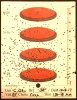
The guns in that last graph shooting open chokes at 20 yards produced these holes:
Keep in mind that these are "real" holes, that is, of a specific, defined area (and larger). They just randomly appear in a pattern or two, not in the others. Looking at patterns with no standard of area which would define a "hole" is a waste of time, especially since they are due to chance and nothing else.
Mistake #3.
"by adding or lessening choke constriction ..."
This mistake is part of an earlier one and adds something new. It presumes, in error, that you can eliminate holes by adding or lessening constriction and adds the assumption that you can "fix" errant patterns by looking at them and grinding on the choke.
Mistake #4,
"The odds of that hole being in another pattern in the same exact place is ZERO"
First, this is a straw man argument, since no one ever said that holes would be in the same place. The proper response is "So what."
Also, it discloses the fatal weakness of the "holes" argument in total.
When I first got seriously interested in trapshooting I wanted to know everything so I read everything, including Oberfell & Thompson's
"The Mysteries of Shotgun Patterns." I believed every word, made up insanely-complicated data sheets, and went out patterning expecting that it would tell me which of my barrels was best, which least good. There was a whole "decision tree" which would lead me right.
By the time I'd shot three patterns, I knew it was a house of cards. Yes, this gun's pattern had two holes in it of 5" diameter, but this second one didn't have any, and this third on a single hole but in a different place then the first one. Clearly, holes were random and not related to the quality of the barrel. And remember, it was barrels that O & T were rating, while in fact barrels shoot the same, generally, as long as they have similar choke (look at all those examples above) and the differences are in the shells, not the hardware.
I'll get to that I think the poster above means by "Kiner's method" after a while, but I'll call it TBR since I don't know that Kiner's method is but I do know what TBR's claim to do.
Yours in Sport,
N1H1



 I didn't read everything but from what I read the conclusions seem logical. There is a reason why high end guns are much more expensive and it has a lot to do with producing better and more consistent patterns. The first time I shot my K80 Trap Special on paper I literally admired the pattern. The pellets were "evenly spaced." Anyway, you can have the best shooting gun, but its always the person behind it that matters.